


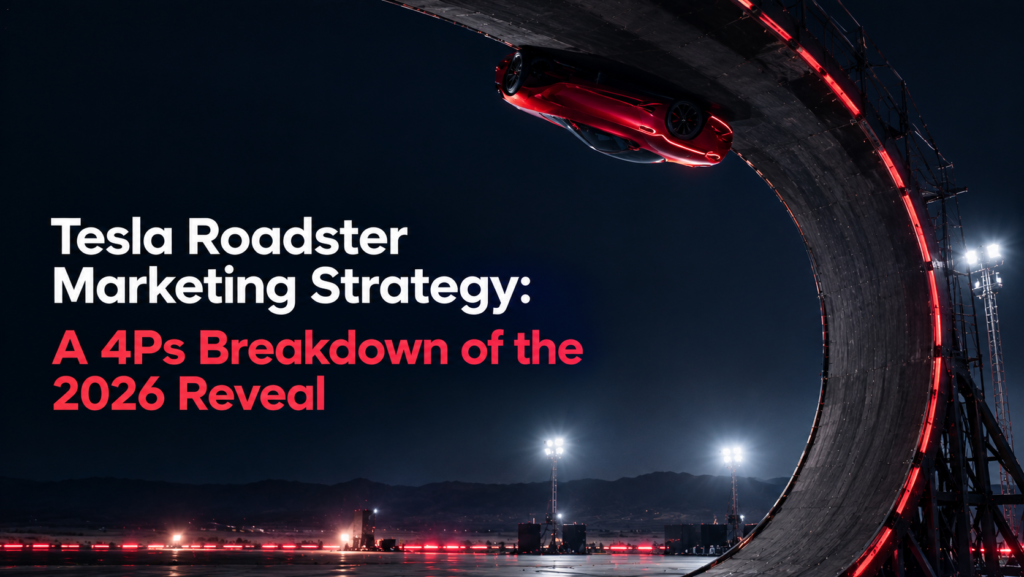
On 15 October 2026, Tesla unveiled its long-delayed Roadster at a livestreamed event in Texas. The prototype drove up a curved ramp and upside down, turned in the air and landed using cold-gas thrusters. Tesla claims it reaches 60 mph in under a second and promises a top speed of 230 mph. Then came the fine print: production will not start until 2028, there is no final price, and reservations are $50,000 each. Viewed purely as marketing, this is a fascinating launch. Here is a Tesla Roadster marketing strategy breakdown using the classic marketing mix: positioning, product, price, place and promotion.
What did Tesla announce, and what didn’t it?
Reuters reported that Musk said the revamped Roadster will not enter production until 2028, that no final sticker price was given, and that reservations are $50,000, down from the $200,000 listed previously. It is also unclear whether some of its more dramatic features will be street legal. For context, Tesla said in 2017 that this next-generation Roadster would arrive in 2020. Everything below is read against those facts.
Positioning: a halo car, not a volume product
A Morningstar analyst quoted by Reuters expects Tesla to sell about 2,000 Roadsters a year, against 1.6 million vehicles sold last year. The Roadster is not positioned to make money. It is positioned to make the rest of the range feel more advanced, which is what a halo product does. The target audience for the car is a few thousand buyers. The target audience for the story is everyone else.
Product: the demonstration is the message
Tesla did not describe the product, it showed it: a car driving upside down, turning in the air and landing on thrusters. That is a far stronger message than any spec sheet, and it gives people something to retell. The gap to watch is between the demo and the product. Reuters notes it is unclear whether some features will be street legal, so the thing people remember may not be the thing people can buy. A great demo creates an expectation that the shipping product then has to meet.
Price: reservation-led, with no sticker price
Our analysis: Tesla is selling the commitment before the price. A $50,000 reservation filters for serious buyers, produces a visible demand number and brings in cash years before delivery. Cutting it from $200,000 widens the pool of people who can raise their hand. The risk is that buyers commit without knowing the final price, which can turn into frustration or refunds if the number lands higher than expected.
Place: direct and livestreamed
Tesla sells directly to customers rather than through a dealer network, and the reveal followed the same logic: a livestreamed event anyone could watch, with the reservation link as the call to action. There was no dealer launch tour and no media junket, because the stream was the distribution channel and the audience was global from the first minute.
Promotion: earned attention built around one moment
Our analysis: the promotion was the event itself. Tesla has historically relied on word of mouth and media coverage rather than traditional advertising, and this launch followed the pattern, one spectacular moment designed to be covered and shared. The original Roadster famously flew to space on a SpaceX Falcon Heavy in 2018, and this reveal reuses the same playbook of spectacle plus a famous founder. It works when the brand is already famous and demand exceeds supply, which is a condition few businesses can count on.
Where is the marketing risk?
The biggest risk is time. A 2017 promise of a 2020 car is now a 2028 production date, and trade commentary has asked whether hype can last that long. Attention decays, competitors ship, and a dramatic demo invites scrutiny if reality lags. The strongest launch spectacle in the world does not replace a delivery date you can keep.
Get daily marketing tips, growth strategies & behind-the-scenes wins. Follow @azizi_media on Instagram — where we share what actually works in digital marketing.
Scorecard
- Worked: halo positioning, a demonstration instead of claims, reservations as a demand signal, one concentrated moment
- At risk: the gap between demo and product, no price at the point of commitment, a delivery date nine years after the first promise, dependence on a single famous founder
What can any business take from this?
- Make a demonstration your message: show the result rather than describing it. Short video is the usual way, which is central to our social media work
- Build your launch around one moment instead of a dozen small posts
- Turn interest into a number with a deposit, waitlist or booking fee
- Set a delivery date you are certain you can beat
- Don’t rely on free attention unless you already have an audience. Put paid reach behind your moment, with tracking from day one. Our comparison of Google Ads and Meta Ads is a good place to start, and our guide to how long SEO takes covers the slower channel
If you would like help turning one idea into a launch plan, talk to us about performance marketing.
FAQ
1. When will the Tesla Roadster be available?
Musk said production will not begin until 2028. No final price has been announced, and reservations were reported at $50,000 each. Check Tesla’s own site for current terms, since they may change.
2. What is Tesla’s marketing strategy for the Roadster?
Position it as a halo car, let a live demonstration carry the message, take reservations before announcing a price, and rely on earned attention from a single livestreamed event rather than conventional advertising.
3. Does Tesla advertise?
Tesla has historically relied on word of mouth, owner referrals and media coverage rather than traditional advertising. Practices can change, so check current reporting before quoting this.
4. What is a halo product?
A flagship item that lifts the perception of the whole range, even if few people buy it. The Roadster is a halo car for Tesla.
5. Is Azizi Media affiliated with Tesla?
No. This article analyzes publicly reported facts about the Roadster reveal and is not connected to Tesla in any way.
Facts about the reveal are from Reuters reporting, Tesla Roadster revamp won’t enter production until 2028, updated 17 October 2026, and may have changed since. Pricing and promotion commentary is our own analysis.