


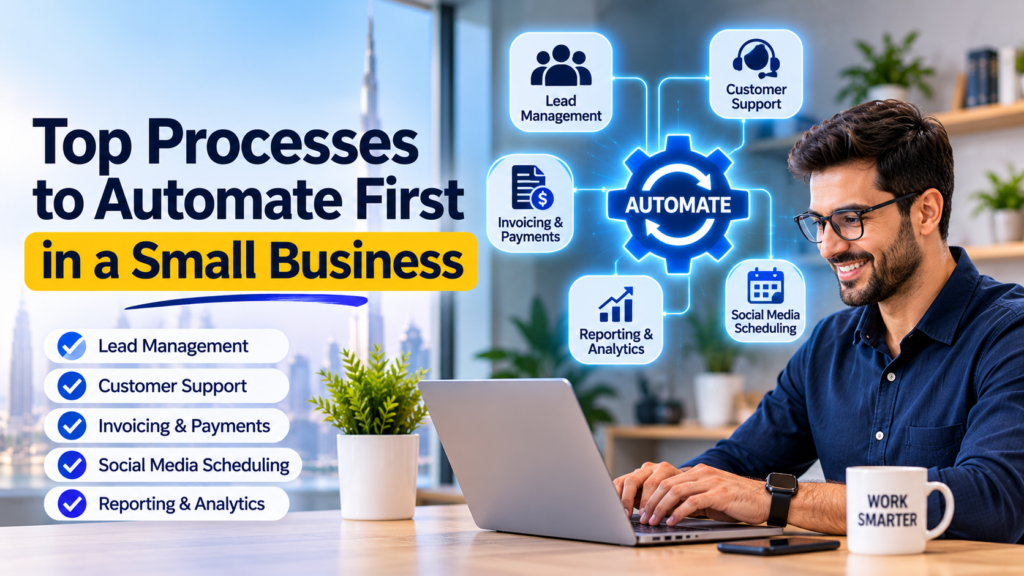
Almost every small business we talk to, whether they’re in Dubai, Mumbai, or elsewhere, asks the same first question before working with an automation agency: where do we actually start? This is a practical, prioritised checklist — not a deep ROI breakdown (see our business automation ROI guide for the numbers side) — of which processes to automate first, in order, and why.
1. Lead and enquiry follow-up
This is almost always the right place to start. If a new enquiry — from your website, WhatsApp, or an ad — doesn’t get an acknowledgement within minutes, you’re losing business to whichever competitor replies first. Automating the first response (even a simple “thanks, we’ll be in touch shortly” with a qualifying question) is low-complexity to build and has the most direct, measurable impact on revenue of anything on this list.
2. CRM entry
If your team is manually typing enquiry details into a CRM or spreadsheet, this is where leads quietly go missing — someone forgets, gets busy, or makes a typo that loses the contact. Automating CRM entry so every enquiry is logged the moment it arrives, with no manual step, closes this gap entirely.
3. Appointment and payment reminders
Reminders are predictable, repetitive, and carry almost no risk if automated — there’s no judgement call involved in reminding someone about a confirmed booking or an overdue invoice. This is typically one of the fastest automations to build and the one with the clearest, most immediate payback in reduced no-shows and faster payment.
4. Reporting
If someone on your team spends an hour or more each week manually pulling numbers from ad platforms, your CRM, or spreadsheets into a report, that’s a clear automation candidate. It doesn’t generate revenue directly the way lead follow-up does, but it frees up real hours every week with very little ongoing maintenance once built.
5. Everything else — once the basics are stable
Chatbots, AI receptionists, multi-step onboarding flows, and custom AI agents are all genuinely useful, but they’re judgement calls best made after the first few automations are running reliably. Trying to automate everything at once usually means nothing gets tested properly before the next thing is added.
Get daily marketing tips, growth strategies & behind-the-scenes wins. Follow @azizi_media on Instagram — where we share what actually works in digital marketing.
What to deliberately leave manual, for now
Anything involving real judgement — pricing exceptions, complaints, unusual requests — should stay with your team until you have a track record of simpler automations working well. Automating judgement-heavy work too early is where automation projects tend to go wrong.
FAQ
What’s the single highest-impact automation for a small business to start with?
Automated lead follow-up, almost without exception. It directly affects whether an enquiry turns into a customer, and slow replies are one of the most common, most fixable reasons small businesses lose business they should have won.
How many processes should I automate at once?
Start with one or two. Trying to automate five processes simultaneously makes it hard to know which change actually worked, and harder to fix something if it breaks. Build, test, stabilise, then add the next one.
Is there a process I shouldn’t automate at all?
Anything requiring real judgement — a pricing negotiation, a sensitive complaint, an unusual one-off request — should stay with a person. Automation works best on repeatable, predictable work, not every task in your business.
How do I know if a process is “repetitive enough” to automate?
Ask whether it happens the same way, triggered by the same kind of event, most of the time. If the answer is yes — a new enquiry, a booking, an invoice due date — it’s a strong automation candidate, regardless of which industry you’re in.
Does the order matter, or can I just automate whatever feels most annoying?
The order in this guide is based on impact versus complexity, not just annoyance. Something that’s mildly annoying but low-impact isn’t worth automating before something that’s directly costing you leads, even if the lead-follow-up fix takes slightly longer to build.