


Last updated: 21 September 2026
Most businesses that try automation start in the wrong place — automating something minor, seeing modest results, and concluding automation isn’t worth the effort. The businesses that actually see the ROI numbers below start with a small, specific list of high-friction processes, not everything at once. Here’s that list, and what it actually returns.
What’s the real ROI of business process automation?
Industry research puts the average ROI of business process automation at around 240%, and industry surveys of small businesses report 300–1000% ROI in the first year — driven by time savings, fewer errors, and revenue that would otherwise be lost to slow or inconsistent follow-up. Most businesses in these surveys report meaningful ROI within 30–60 days of their first deployment, with payback accelerating as more processes get automated. For a business with 5–25 employees, industry estimates suggest that automating lead follow-up, onboarding, invoicing, and reporting together typically recovers $30,000–$80,000 in annual value.
What should you actually automate first?
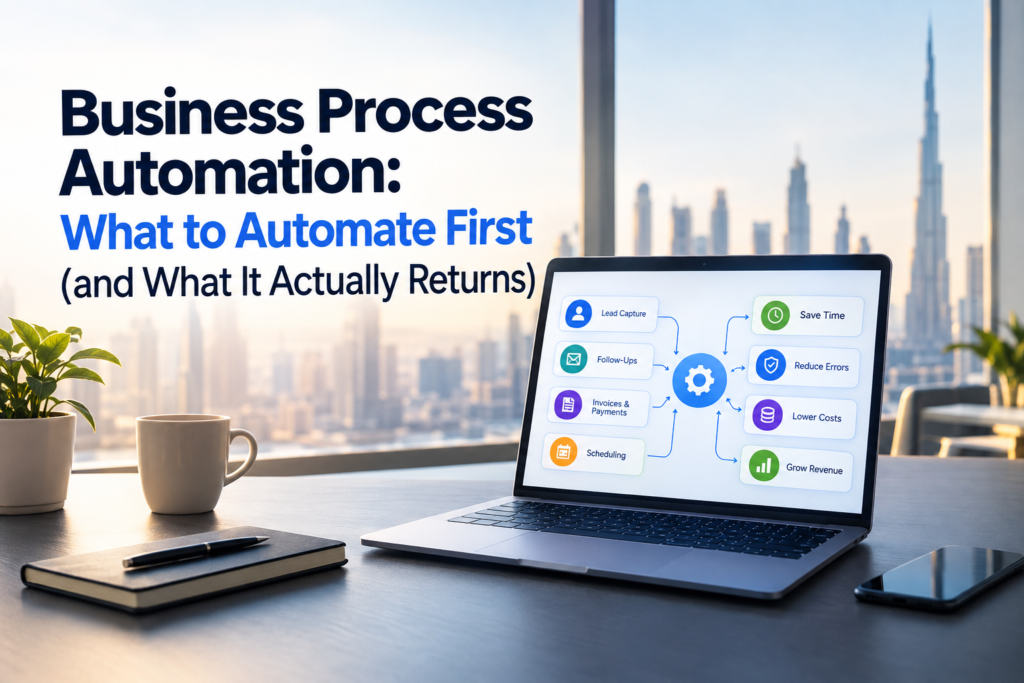
Not everything deserves automation — the highest-return targets share three traits: they happen often, they’re time-sensitive, and a human doing them manually is either slow or inconsistent. In order of typical ROI:
1. Lead follow-up
The single highest-leverage automation for most businesses. A lead that gets an instant response converts dramatically better than one that waits until the next business day — and a human team simply can’t reply instantly to every inquiry around the clock. Automating the first response (even a simple acknowledgment plus routing) captures revenue that’s otherwise lost to slow follow-up. For many businesses, the fastest channel for that first reply is WhatsApp — our WhatsApp marketing guide covers how that works and what it costs.
2. Appointment and order confirmations
High-volume, low-complexity, and exactly the kind of repetitive task that eats staff time without needing human judgment. This is also usually the fastest to implement — often live within 1–2 weeks.
3. CRM data entry and lead routing
Manual data entry is where leads quietly get lost — typos, forgotten follow-ups, leads sitting unassigned. Automating capture-to-CRM removes an entire category of preventable revenue loss.
4. Reporting across tools
Pulling numbers from an ad platform, a CRM, and a spreadsheet into one report is repetitive, error-prone, and rarely anyone’s favorite task — a strong candidate for full automation with minimal risk, since the output is internal, not customer-facing.
5. Invoicing and payment reminders
Time-consuming and easy to delay under real deadline pressure — exactly the kind of task that benefits from running on a schedule rather than depending on someone remembering to do it.
Get daily marketing tips, growth strategies & behind-the-scenes wins. Follow @azizi_media on Instagram — where we share what actually works in digital marketing.
What shouldn’t you automate yet?
Anything where a mistake is costly and judgment genuinely matters — final pricing decisions, sensitive customer complaints, anything requiring real negotiation. Start automation on the repetitive, high-volume, low-judgment work first; expand into more complex workflows once the simple ones are running reliably.
How long does automation take to pay for itself?
Most businesses see meaningful ROI within 30–60 days of their first deployment. A single automation (like lead follow-up) can be live within 1–2 weeks; a fuller system spanning CRM, WhatsApp, email, and reporting typically takes 3–5 weeks to implement properly. The payback period shortens as more processes run on the same underlying system, since the setup cost is shared across them.
What tools actually run these automations?
Most small-business automation today runs on a combination of a workflow platform (Make, n8n, or Zapier) connecting your existing tools — CRM, WhatsApp, email, ad platforms — with AI models increasingly handling the parts that used to need a human’s judgment (reading and categorizing an inbound message, drafting a first-pass reply, extracting information from a document). The 2026 shift worth knowing: newer AI models are meaningfully better at multi-step tasks and staying on-task through a workflow than models from even a year ago, which is why automations that used to need constant human correction are becoming genuinely reliable — see our piece on what GPT-6 Astra changes for business automation for more on that shift specifically.
FAQ
Is business automation only for large companies?
No — small businesses (5–25 employees) are actually the fastest-growing segment adopting automation, and often see the highest relative ROI because manual processes cost them proportionally more time.
What’s the minimum size business that benefits from automation?
Any business with repetitive, high-volume tasks — lead follow-up, appointment confirmations, reporting — benefits regardless of size. The question isn’t company size, it’s process volume and repetition.
Do I need technical skills to use business automation tools?
Not to use a properly built system — the setup requires technical work, but a well-designed automation should run invisibly for your team, with no code or technical knowledge needed day-to-day.
What’s the very first automation I should set up?
Lead follow-up, almost always — it has the fastest payback because it directly captures revenue that’s otherwise lost to slow response times.
How does Azizi Media approach business automation for clients?
We start by identifying the 2–3 highest-friction processes in your business — usually lead follow-up and CRM routing — and automate those first before expanding. See our business automation approach →