


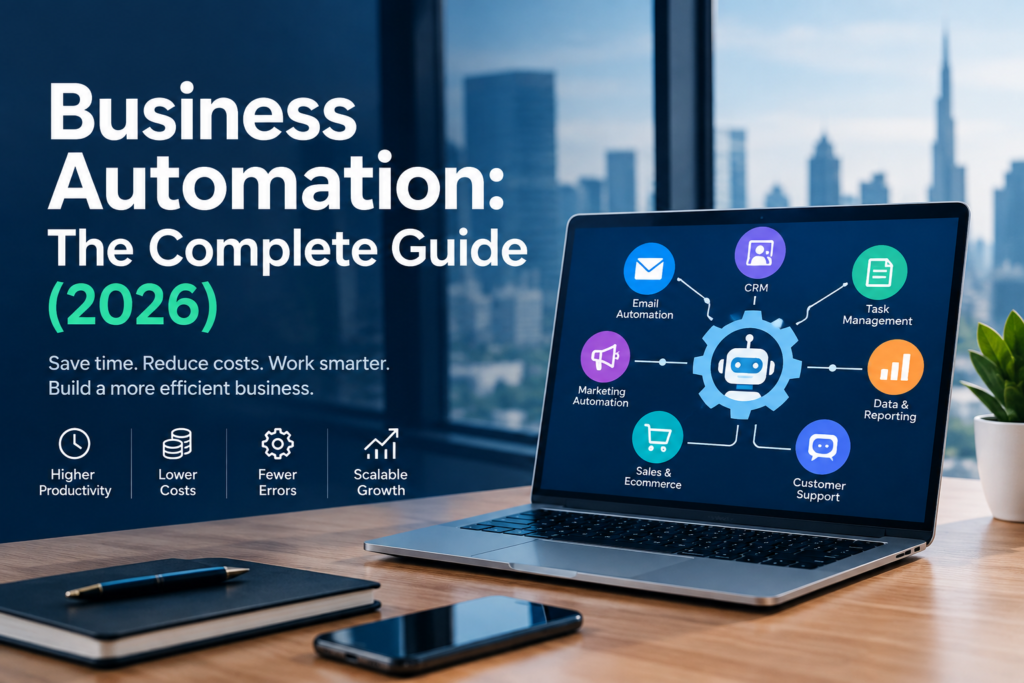
“Business automation” gets used loosely — as a synonym for software, for AI, for “doing less manual work.” Here’s what it actually means, the main types that matter for a growing business, what it really costs and returns, and how to get started without over-engineering something a spreadsheet could have solved.
What is business automation?
Business automation is the use of software and AI to carry out repetitive business tasks and workflows without a person manually performing each step — from a single automated email trigger to a full multi-system workflow connecting your CRM, communication channels, and reporting. It ranges from simple (“send a confirmation email when a form is submitted”) to complex (“read an inbound lead, qualify it, route it to the right person, and follow up automatically until it’s actioned”). The common thread: a task that used to require a human doing the same repetitive action now runs on its own.
What are the main types of business automation?
- Marketing automation — email sequences, lead scoring, ad campaign management, and audience targeting that runs on rules rather than manual scheduling
- Sales automation — lead routing, CRM updates, follow-up sequences, and pipeline tracking that happens automatically as deals move
- Customer service automation — chatbots, automated first responses, WhatsApp/email triage, and ticket routing
- Finance and operations automation — invoicing, payment reminders, expense processing, and recurring reporting
- HR automation — onboarding sequences, document collection, and scheduling
- Workflow/process automation — the connective layer tying the above together across tools, often the highest-value category since it removes the manual handoffs between systems
Most businesses start in one category (usually marketing or sales) and expand once the first automation proves itself.
How big is business automation as a category, and is it actually growing?
The business process automation market was valued at roughly $13 billion in 2024 and is projected to reach $23.9 billion by 2029 — an 11.6% annual growth rate. Notably, small and mid-sized businesses are the fastest-growing segment of automation adopters, growing at 15.2% annually through 2030, faster than large enterprise adoption. This isn’t an enterprise-only trend anymore — it’s increasingly where small business growth is coming from.
What does business automation actually return?
Industry research puts average ROI from business process automation at around 240%, with small businesses often seeing 300–1000% ROI in the first year specifically — driven by time saved, fewer errors, and revenue that would otherwise be lost to slow manual follow-up. Separately, Salesforce’s SMB Trends research found 91% of small and mid-sized businesses using AI tools report it boosts revenue, and 90% report it improves efficiency. For the full breakdown of what to automate first and realistic payback timelines, see our dedicated guide on business automation ROI.
What tools power business automation in 2026?
Most small-to-mid-sized business automation today runs on a workflow platform — Make, n8n, or Zapier are the most common — connecting the tools you already use: your CRM, WhatsApp Business, email, and ad platforms. Increasingly, AI models handle the parts that used to require human judgment: reading and categorizing an inbound message, drafting a first-pass reply, or extracting information from a document. Newer AI models have become meaningfully more reliable at multi-step tasks specifically, which is changing what’s realistic to automate — see our piece on what GPT-6 Astra changes for business automation for more on that shift.
Get daily marketing tips, growth strategies & behind-the-scenes wins. Follow @azizi_media on Instagram — where we share what actually works in digital marketing.
Is business automation worth it for a small business?
Yes, for the right processes — but not for everything. Automation pays off fastest on tasks that are repetitive, high-volume, and time-sensitive, where a human doing the same thing over and over is either slow or inconsistent (lead follow-up is the clearest example). It pays off slowest, or not at all, on tasks requiring genuine judgment — pricing decisions, sensitive customer complaints, real negotiation. The mistake most businesses make isn’t automating too little, it’s trying to automate everything at once instead of starting with the two or three highest-friction processes.
How do you get started with business automation?
- Identify your highest-friction repetitive process — usually lead follow-up, appointment confirmations, or manual CRM entry
- Map the current manual steps before building anything — automating a broken process just breaks it faster
- Start with one automation, not a full system — prove the value before expanding
- Connect it to what you already use — a workflow platform linking your existing CRM/WhatsApp/email is usually faster and cheaper than replacing your tools
- Expand gradually — once the first automation runs reliably, add the next highest-friction process
FAQ
What is the difference between business automation and AI?
Automation is the broader category — using software to run tasks without manual repetition. AI is increasingly a component within automation, handling the parts that need judgment (reading a message, drafting a response) rather than just following a fixed rule. Modern business automation typically combines both.
Is business automation only for large companies?
No — small and mid-sized businesses are currently the fastest-growing segment adopting automation, and often see the highest relative ROI since manual processes cost them proportionally more of their limited time.
How much does business automation cost to set up?
It varies widely by scope — a single automation (like lead follow-up) can be relatively quick and inexpensive to set up; a fuller system spanning multiple tools takes longer and costs more, but usually pays for itself within the first few months based on industry ROI data.
What should I automate first in my business?
Lead follow-up is almost always the highest-return starting point, since it directly captures revenue otherwise lost to slow response times. See our full breakdown of what to automate first.
How does Azizi Media approach business automation for clients?
We start by identifying the 2-3 highest-friction processes in a business — usually lead follow-up and CRM routing — and automate those first before expanding into a fuller system. See our business automation approach →